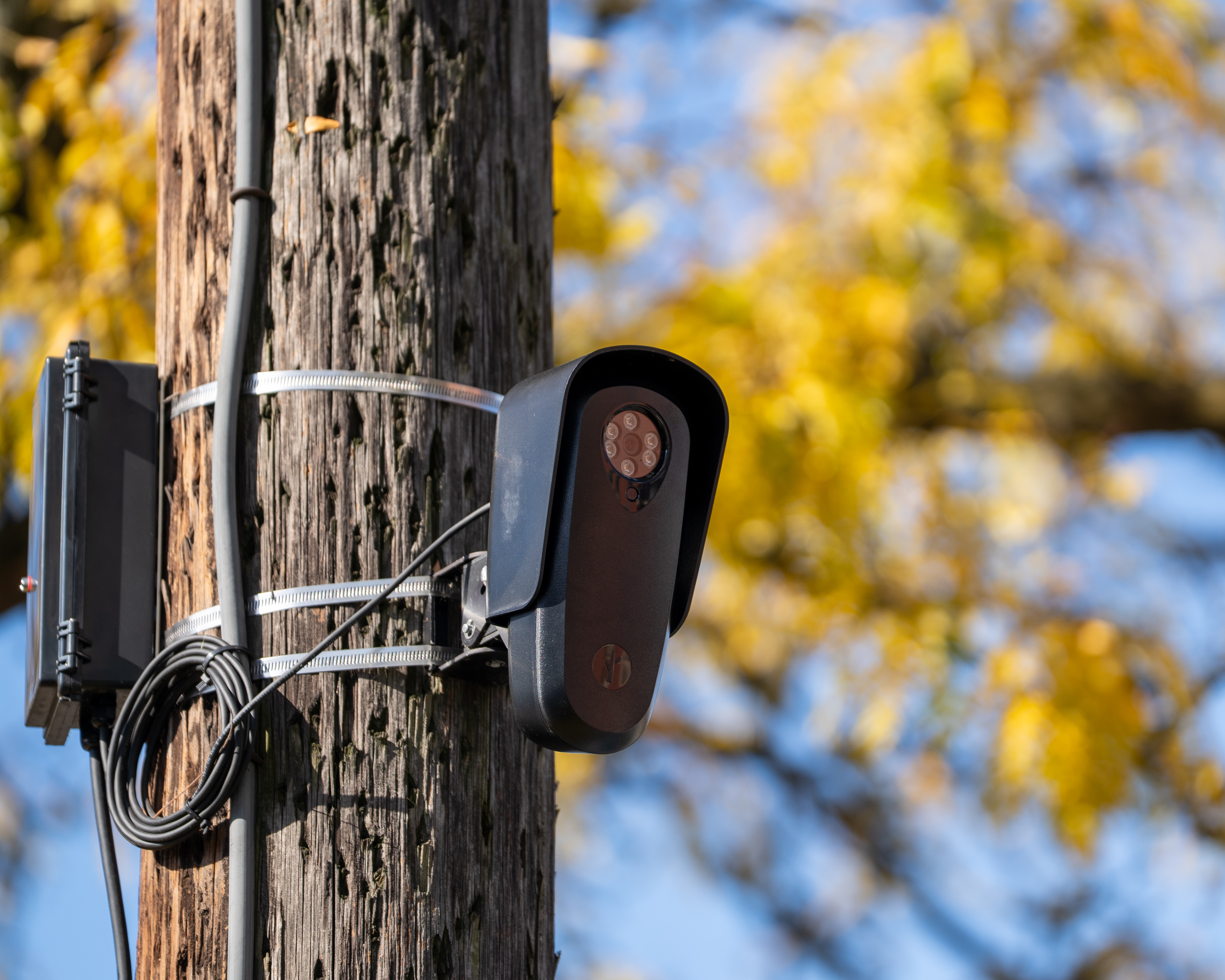
In late 2023, Tompkins County law enforcement installed artificial intelligence cameras around Cornell University, Ithaca Commons and Ithaca College. These cameras were contracted from a private security company called Flock Safety and have been used to help local agencies read license plates and detect gun shots.
This October county legislators voted to decide if the county would continue to accept the state funding that pays for the cameras. The vote passed in a 9-4 decision, but concerns about the cameras proliferated before and since.
Nine Legislators Voted For AI Cameras to Increase Public Safety
Sophia Scime
A current controversy being discussed in Tompkins County is the recent installation of AI Flock Safety cameras.
Nine of 14 Tompkins County legislators voted in favor of the cameras. Legislator Dan Klein is one of those nine. Klein explained his reasoning for his vote.
“This is a law enforcement tool,” Klein said. “This is a balance between civil liberties, privacy and also public safety.”
Legislator Rich John was also among the legislators who voted in favor. John stated why he thought the cameras were influential enough to keep.
“One of the big factors for me was, like, two years ago there was a real bump in gun violence in our city,” John said. “ … and Ithaca doesn’t have that.”
John then went on to say that part of the reason gun violence has declined was due to license plate readers.

Legislator Deborah Dawson entered the vote with the expectations of voting against the cameras.
Dawson’s opinion was swayed by the persuasion of Legislator Travis Brooks, who managed to convince her to vote in favor.
“Travis Brooks spoke eloquently about how important this grant was to saving the lives of young people in his district,” Dawson said. “We couldn’t get the grant without the Flock cameras.”
When Klein, John and Dawson were asked if they think the public should get a say as to where the cameras are placed they all said no, their argument being that the decision should be left up to law enforcement.
An issue that would cause all of them to re-evaluate their votes was the concern of information being leaked to corporations such as U.S. Immigration and Customs Enforcement. Dawson explained the circumstances it would take for her to switch back to her original stance.
“If we received evidence that our data was actually being misused in ways that are inconsistent with our values in Tompkins County,” Dawson said. “ … Protecting our marginalized communities, protecting our immigrants.”
As of now, these cameras are being used to protect the county thanks to the Legislators Deborah Dawson, Rich John, Anne Koreman, Greg Mezey, Lee Shurtleff, Mike Sigler, Travis Brooks, Randy Brown and Dan Klein who voted in favor.
GIVE Grant Causing Inevitable Backlash
Joey Scherkenbach
In a country with a concerningly high amount of gun violence, communities recognizing its severity and wanting to fix the problem may come rather easily.
However, communities aligning on the exact methods to reduce gun violence has yet to come to fruition.
On Oct. 7, the Tompkins County Legislature voted to accept a $220,650 Gun Involved Violence Elimination (GIVE) grant that funds the county’s Flock Safety program. Of that $220,650, the Ithaca Police Department received $150,485, and the Tompkins County Probation Department obtained $50,820.
Flock Safety is a Georgia-based security company which deploys outdoor cameras at various stoplights within communities to record all license plates that drive through its sight and detect any gunshots. Theoretically, the cameras detail crimes and help local law enforcement seek out suspects.
Although the majority of Tompkins County legislators (nine out of 13) voted in favor of accepting the grant to continue using Flock cameras, legislator Shawna Black was one of four who did not.
“We definitely had an outcry from our community [of Ithaca, New York] members and constituents,” Black said. “There were privacy concerns… you’re trusting a for-profit organization to have your private information… Despite the fact that we have a sheriff who says, ‘I’m not going to share our data with other communities,’ there absolutely is a way for other municipalities in New York State to look at our data.”

Black also noted the risk of the federal government accessing the information.
Furthermore, since the cameras operate on a database around the country, she feared that Immigration and Customs Enforcement (ICE) would use the data to specifically target undocumented workers, which was not the original purpose of Flock Safety.
Additionally, Black reported that in Texas, the authorities used Flock’s data to locate and indict women who have had abortions.
“They’re using it as a tool to criminalize actions [like abortions] that really should not be criminal, and they’re making money on it,” Black said.
Black clarified that the financial grant from GIVE had no impact on her vote; she would not support the usage of Flock cameras regardless.
AI Camera Debates in an Endless Loop
Benjamin Lajoie
The debate over Flock Safety cameras in Tompkins County continues to be a hot topic with lawmakers, police and locals. The cameras, which use artificial intelligence to scan license plates, were recently given a year’s worth of funding. Supporters argue the technology helps prevent gun violence while others believe it is an overkill of surveillance.
Matt Butler, editor in chief of The Ithaca Voice, experienced the meeting firsthand and got to sit in with the lawmakers. He felt that while time was spent talking about the issue and was taken seriously, it was productive and unproductive at the same time.
“Tense but productive in a way,” Butler said. “They talked about the issue but talked in circles.”

Butler thinks that the technology may not even be necessary in Tompkins County.
“A lot of people I’ve talked to, myself included, just don’t feel the cameras are needed here,” Butler said. “Gun violence is a serious issue, but this area isn’t a high-crime community. There are other ways to invest in safety that don’t involve this level of monitoring.”
Butler also said he was disappointed that more effort was not made to find other options before renewing the contract.
“I haven’t heard anything about any alternative being explored,” Butler said. “The county could have looked into more community-based programs or preventive measures instead of defaulting to more surveillance.”
Butler stated he doubts the county will renew its contract with Flock Safety once it expires.
“There’s too much public skepticism and not enough hard results,” Butler said. “I think next year, the legislature will look for other ways to address safety without relying on surveillance.”
Local Hotel Manager Weighs in on GIVE Grant
Brad Romano
The AI Flock Safety cameras in Ithaca, N.Y., have led to concerns among many residents.
Surveillance cameras in Ithaca, N.Y., record footage 24/7, which leads to an invasion of privacy for certain residents.
Those are just some of the very few things residents have said about these cameras. However, how do workers feel about it? Do they think that it affects their business? With multiple cameras being near certain companies, many people are raising questions.
The general manager of Hampton Inn Ithaca, Stephanie Lyon, believes that these cameras could help the homelessness issue in the town, especially since it is affecting her business in a negative way.
“I know from a business standpoint that the homeless community has increased a lot. So there’s a lot more car break-ins,” said Lyon. “There’s a lot more activity that’s happening. So we’re able to kind of look back if they need to see what happened.”
Lyon, although pleased with the business side of things, wasn’t about the privacy aspect.

“It’s almost like an invasion of privacy,” Lyon said, “An invasion of privacy is like seeing your license plate. Why do they need to see it if you’re not doing anything wrong?”
The license plate issue has been one of the main topics with Ithaca residents regarding the cameras.
The company that is in control of these cameras, Flock Safety, is a private company, meaning that profit is something they are motivated by.
“Being in a hotel, if I have anybody that comes in and is like, I need to see your camera footage, no, you have to have a warrant, right? So I do not, again, it’s the business’s private, like it’s their right to either share or deny that,” Lyon said.
Flock Safety has released general knowledge of the cameras, but Lyon believes there needs to be more information coming out.
“I think there definitely needs to be some more information given, ” said Lyon. “What information specifically? Like, you know, the process for it, how they handle it, why they’re doing it, what are they actually getting out of it, who’s seeing this information, things like that.”
Tompkins County Sheriff Faces Skepticism for Role in Legislative Session
Grayson Rivers
Immigration enforcement. Abortion restrictions. Gun violence. In the vote to renew Tompkins’ AI surveillance camera contracts, these were the issues that divided the county legislature. None doubted the validity of these issues, but the 14 chamber members were forced to choose between what mattered more: their mistrust of the contracted company Flock or the continued use of its cameras aiming to reduce gun violence.
Lorien Tyne was the Ithaca Times reporter assigned to cover the proceedings. For months, she watched concerned legislators and Ithaca residents go back and forth with Flock spokespeople and local law enforcement agencies.
Eventually, the Tompkins Sheriff Department’s adamant noncompliance with U.S. Immigration and Customs Enforcement and strict data privacy regulations proved effective in persuading nine legislators to accept the state’s Gun Involved Violence Elimination (GIVE) grant, which has covered the costs of the cameras for the past two years.
The dissenting members, however, still had reservations about Flock’s cooperation with ICE and other law enforcement agencies for investigations into undocumented persons and cases of illegal abortions in other states.
Three weeks passed, but something from that day continued to frustrate Tyne. During the final legislative session, legislator Shawna Black asked Tompkins County Sheriff Derek Osborne if lawmakers could accept the grant without its Flock security camera component. Osborne responded that he didn’t think it would be possible.
Tyne says this isn’t true. The GIVE initiative requires law enforcement agencies to submit a plan for combating gun fire and other violent crime in a loose commitment to Problem-Oriented Policing, but there is no requirement for Flock cameras to be a part of it.
“It wasn’t clear that the [law enforcement agencies] were making the decision to have the Flock cameras, and that it wasn’t actually as tied to the GIVE grant as they were making it sound,” Tyne said.

Travis Brooks, Legislator for the 1st Tompkins County District, delivered a floor-silencing explanation for his yes vote. He recounted being present at the aftermath of a number of fatal shootings, which he and Tynes believe have been overlooked due to public perception of Ithaca as a universally safe space. He commended the concerns his fellow council members had about Flock, but said he had to put the young people in his immediate community first.
As it’s written, the GIVE protocol didn’t require him to choose at all. Similar cameras or entirely different police measures could be paid for using the same state funding, and according to Tyne, the Department of State says that law enforcement agencies make amendments to their plans regularly.
“I also found it frustrating that our local government isn’t asking these questions before they’re making these decisions,” Tyne said. “I was hoping that they had a bit more understanding of how the GIVE grant worked.”
Though the grant was accepted with what Tynes considered an odd fixation on Flock cameras, she still questions the way misinformation has impacted the Tompkins community.
“Whether it was misdirection, whether it was just lack of preparation or misunderstanding, I don’t know, but I thought that not only were they making their decision based on some misinformation or misunderstanding, but they were also telling that to the public,” Tyne said. “Anyone watching that meeting, and anyone at that meeting, kind of walked away from that thinking that the GIVE grant money was really tied up in Flock, and that’s just not the case.”
Ithaca Police Chief sees Flock Cameras as a Helpful Tool
Cole Sanders
The Flock Safety camera system, approved by Tompkins County legislators, has raised concerns from residents, but Ithaca Police Department Chief Thomas Kelly argues that those concerns may be misplaced.
In an interview, Kelly reframed the nature and purpose of the security system. He clarified that they aren’t surveillance cameras in the traditional sense, but rather “license plate readers.”
These plate readers are “very similar to the license plate readers that are across the state on major highways, the same plate readers that they use for E-ZPass,” said Kelly.
The chief also added that the plate readers have proved helpful in situations such as “homicides and different violent crimes, where they were instrumental in providing leads,” showcasing the potential benefits this system brings to Tompkins County.
The ability for law enforcement to narrow down a search from all cars resembling the suspect’s to one license plate caught on a Flock camera will also help curb “subjecting people to unnecessary police contact,” said Kelly, which will also hasten the search for possibly violent offenders.
While Kelly clearly sees the benefits of the Flock cameras, he and the IPD recognize the public’s worry about its place in the community.

“We definitely take the public outcry very very serious,” Kelly said. “And as police officers, we take an oath to uphold the Constitution and protect people’s rights.”
He also made it clear that the rights IPD are protecting are not entirely universal, such as the right to privacy in public spaces.
“If you’re in a public place, you release those rights,” Kelly said. “And along the lines of automobiles … there’s an automobile exception … when you’re in an automobile, you relax those rights because you’re in a vehicle that potentially evidence can be gone, disappear, or other ways be tampered with.”
Regarding concerns about Flock Safety, the company behind the cameras, Kelly assures that they are held to the highest standard.
“Even as a private company, their mission is very specific and they have been very outspoken about protecting their data and not allowing people to access it,” Kelly said.
Law enforcement is held to similarly high standards when using the technology, and can lose the privilege if it is misused.
“We’ve seen recently a number of agencies that have been basically cut off from using Flock because they abused the use of that service,” Kelly said.
Concerning the specific placement and quantity of the cameras in the county, Kelly said there is a fairly equal disbursement throughout the area and there are guidelines regarding the types of areas the cameras are able to be placed,
“They didn’t want them within neighborhoods,” Kelly said. “So it was designed more around like main ingress and egress coming in and out of the city.”
Flock Safety Defends Camera Usage after Concerns From the Public
Cadence Ryan
Controversy struck after the Tompkins County Legislature voted nine to four at a meeting held on Oct. 7 to accept the Gun Involved Violence Elimination 2025-2026 grant. This grant funds the county’s Flock Safety license plate reader and gunshot detection cameras.
Flock Safety is a privately owned security company that is involved in over 6,000 communities across the country. According to their website, Tompkins County uses these cameras to collect and store data that can aid law enforcement.
Residents are concerned about potential misuse of these devices by local, state and national agencies. Among these concerns, people are especially worried about the Department of Homeland Security using the data to track immigrants lacking permanent legal status.
The Ithaca Times article, “County Accepts State Grant for Violent Crime Reduction, Including Continuation of Flock Cameras” recaps a Q&A with a flock Safety representative.
Trevor Chandler, director of public affairs for Flock Safety, attended the meeting via Zoom to answer the legislators’ questions.

Chandler gave examples of how Flock Safety cameras have been used to aid investigations of stolen cars, hit-and-runs, and missing persons cases.
He stated that he has no interest in working with U.S. Immigration and Customs Enforcement.
Explaining that Flock Safety has added an optional filter that prevents searches regarding immigration enforcement.
“Our transparency and accountability features make that not impossible to do, but very hard to do,” Chandler said. “If there is an officer that is violating your policy, they can be held accountable for that.”
Our team reached out to Chandler for more information on the cameras but got no response.
DeFlock Gives a Heads Up to Citizens
Erika Seagull
On their website, DeFlock describes who they are and states their goals:
“A community-driven project that maps surveillance devices across the world,” because they want “to shine a light on the widespread use of Automated License Plate Recognition to raise awareness about the threats it poses to personal privacy and civil liberties, and empower the public to take action.”
The organization does this by maintaining an interactive map of ALPR cameras across the world. The data is mostly gathered by volunteers that physically find cameras in their communities. It is unclear what their verification process for posted camera locations is.
DeFlock says that they track ALPRs because “privacy is a fundamental right, and the growing use of ALPRs threatens to erode it.”
DeFlock did not respond to our requests for comment..